Syrian countermeasures, including defensive ballistic missiles, were fired after U.S. and allied weapons hit their targets — Russia initially said Syria shot down 71 cruise missiles
Updated on
- Trump weighed five proposed target plans, person familiar says
- ‘No Syrian weapon had any effect’ on strike, Pentagon says
President Donald Trump’s outrage over another apparent chemical weapons attack by Syrian President Bashar al-Assad was clear. And for the second time in his presidency, the U.S. commander-in-chief demanded retaliation.
As images of sick or dying children flooded global media all week, the U.S. guided-missile destroyer USS Winston Churchill churned toward the Mediterranean to join a flotilla of allied warships, including another U.S. destroyer, the USS Donald Cook.

USS Donald Cook
It was a ruse.
While both vessels carry as many as 90 Tomahawk missiles — the main weapon used in the Friday evening strike on Syria — neither ship in the end fired a shot. Instead, according to a person familiar with White House war planning, they were part of a plan to distract Russia and its Syrian ally from an assault Assad’s government could do little to defend itself against.
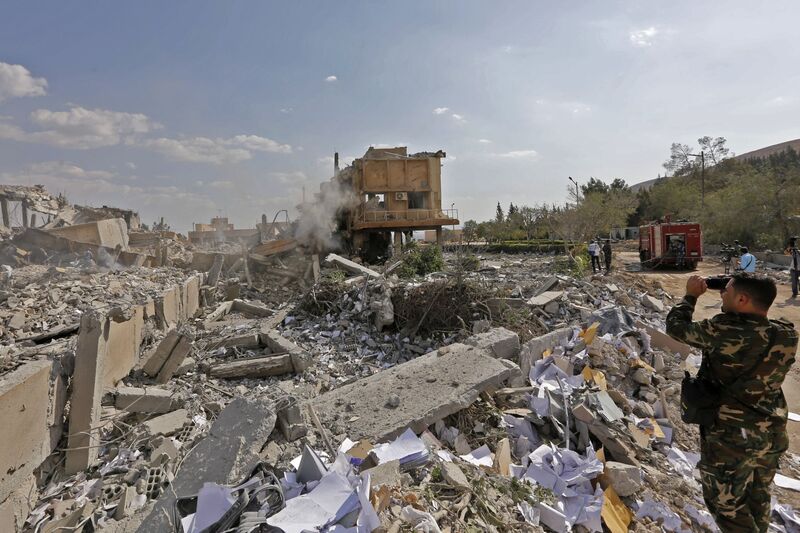
Wreckage at the Scientific Studies and Research Centre (SSRC) compound near Damascus on April 14.
Photographer: Louai Beshara/AFP via Getty Images
It worked. Pentagon officials on Saturday said they faced little resistance to their targeted attack on what they said were three Syrian chemical weapons facilities. Most of the Syrian countermeasures, including defensive ballistic missiles, were fired after U.S. and allied weapons hit their targets, Lieutenant General Kenneth McKenzie told reporters on Saturday.

Lieutenant General Kenneth McKenzie
“No Syrian weapon had any effect on anything we did,” McKenzie said. He described the joint U.S., French and U.K. strike as “precise, overwhelming and effective.”
Brazen as it was perceived to be, the Assad regime’s decision to again use chemical weapons on own people didn’t by itself spur the U.S. to act. The Trump administration was also motivated by how closely the attack followed the use of a nerve agent to poison a Russian ex-spy and his daughter in England in March, an action the U.K. government and its allies blamed on Russia.
The English incident added to concerns held by Trump, his top aides, and leaders in the U.K. and France that not responding might encourage proliferation of chemical weapons, according to two administration officials who spoke on condition of anonymity to discuss the deliberations.
As the strategy of how to respond took shape, Trump appeared to telegraph his intentions to the world with a tweet on April 11: “Russia vows to shoot down any and all missiles fired at Syria. Get ready Russia, because they will be coming, nice and new and ‘smart!”’
Analysts suggested Assad’s regime would respond to Trump’s threats by protectively moving weapons and personnel away from likely targets. An already difficult battle plan — which required hitting Assad without provoking Russian reprisals or injecting the U.S. further into Syria’s seven-year civil war — was getting harder.
‘Big Price’
In the White House, Trump met with military officials and made several calls to his French and British counterparts, President Emmanuel Macron and Prime Minister Theresa May, with the goal of following through on a threat to impose a “big price’’on Syria — a vow made in an earlier tweet, on April 8.
During a meeting with the National Security Council and top military leaders early in the week, Trump had been presented five large target options — called sets — for potential strikes, according to the person familiar with the plans. The president largely listened as Pentagon chief Jim Mattis, Joint Chiefs Chairman Marine Corps General Joe Dunford and other military leaders did most of the talking. New National Security Adviser John Bolton — who started work on April 9 — and Vice President Mike Pence were also on hand.
The president asked Bolton and the military leaders to justify each potential target, and was particularly focused on limiting the risk of escalation by Russia. There was unanimity among Trump’s top national security staff about conducting strikes but debate about how hard to hit the Syrians, the person said.
Haley’s Voice
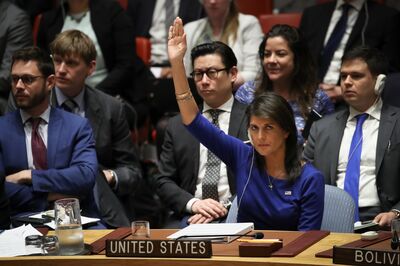
Nikki Haley at a United Nations Security Council emergency meeting on April 14.
Photographer: Drew Angerer/Getty Images
United Nations Ambassador Nikki Haley was especially blunt in her assessment of the Syrian regime during meetings with Trump, the person said.
Haley told the UN Security Council on Friday that Assad and his Russian backers were to blame for the deaths of thousands of Syrian civilians. In a private meeting with Trump and national security officials earlier in the week, Haley was a leading voice pushing for a robust military response to the chemical weapons attack on humanitarian grounds, the person said.
Dunford told reporters Friday that the U.S. sought targets that would limit any involvement with Russian military forces in Syria and reduce the risk of civilian casualties.
Trump, who just a week earlier said he wanted to pull U.S. troops out of Syria “very soon,” didn’t want to become drawn into the civil war there and instead focused the military response on deterring the use of chemical weapons, according to the official.
Missile Barrage
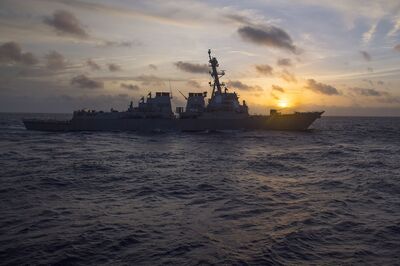
USS Winston S. Churchill
Photographer: Raymond Maddocks/U.S. Navy
With the allies on board and the USS Winston Churchill arriving in the Mediterranean region, the attack was nearly under way.
As the president addressed the nation at 9 p.m. Washington time, on Friday, a barrage of 105 U.S., U.K. and French missiles converged on Syria. They came from the Red Sea, the Arabian Gulf and the Mediterranean, homing in from three directions to overwhelm whatever missile defenses Assad’s regime might deploy. Russia’s more advanced air defense system didn’t engage the allied weapons.
According to the Pentagon, the allied weaponry included 19 new “Extended-Range” stealthy Joint Air-to-Surface Standoff Attack Munitions launched by two B-1B bombers based out of Al Udeid Air Base, Qatar, and six Tomahawk cruise missiles launched from the Virginia-class USS John Warner submarine. The bomber-launched missiles, built by Lockheed Martin Corp., had never been used in combat.
Red Sea Attack
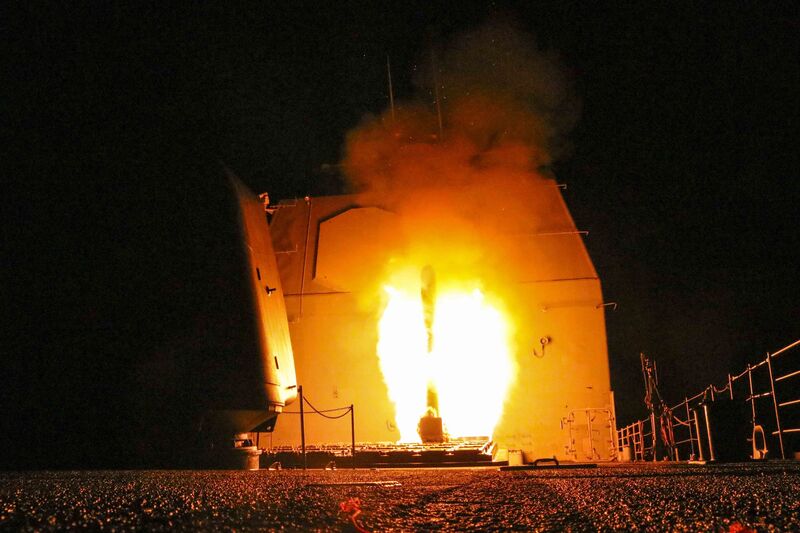
USS Monterey fires a Tomahawk land attack missile at Syria on April 14.
Photographer: Matthew Daniels/U.S. Navy via Getty Images
The cruiser USS Monterey fired 30 Tomahawks and the destroyer USS Laboon fired seven Tomahawks from the Red Sea. The destroyer USS Higgins fired 23 Tomahawks from the North Arabian Gulf, according to McKenzie.
The weapons also included French SCALP-EG cruise missiles and British Storm Shadow standoff missiles launched by Tornado and Typhoon jets. Nine SCALP missiles were fired at what the Pentagon said was a chemical weapons storage complex at Hims-Shinshar, along with two SCALPS, nine Tomahawks and eight Storm Shadows.
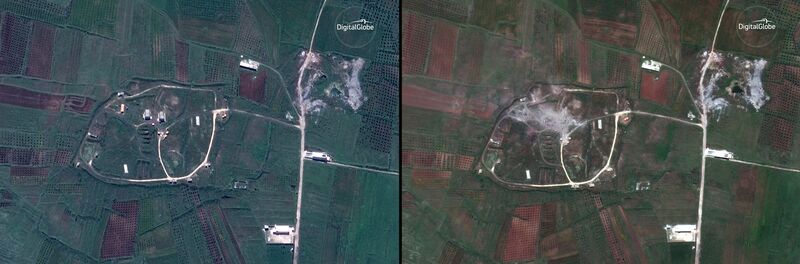
Chemical weapons storage complex at Hims-Shinshar before the strike on April 13, left, and following the strike.
satellite image ©2018 DigitalGlobe
The morning after the barrage, Trump tweeted “Mission Accomplished!”, a phrase closely associated with President George W. Bush. The 43rd U.S. president prematurely declared an end to major combat operations in Iraq in 2003 while standing on the deck of the aircraft carrier USS Abraham, in front of a large banner bearing those words.
Trump, like Bush, may live to regret using the phrase. The latest U.S.-led operation was narrow in scope, with little damage done to Assad’s war-fighting capabilities. The country remains a toxic brew of foreign forces, militias and terrorist groups. Haley, the UN ambassador, said this week that Assad has used chemical weapons dozens of times since war broke out in 2011. He might well use them again.
By Toluse Olorunnipa, Jennifer Jacobs, Anthony Capaccio, and Margaret Talev
Bloomberg
*******************************************
Sputnik
71 Out of 103 Destroyed: Here’s How Syria’s Air Defense Repelled West’s Missiles
Perhaps the most surprising news surrounding the US, British and French strike on Syria Saturday morning was the report that the country’s Air Defense Force managed to shoot down just shy of 70% of the Western cruise missiles launched. Sputnik looks at how the Syrians managed to do it.
The Western attack, executed this morning at 4:00 am Syrian time on April 14, saw US Navy warships in the Red Sea and Air Force B-1B bombers and F-15 and F-16 aircraft rain dozens of ship and air-launched cruise missiles down on the Syrian capital of Damascus, an airbase outside the city, a so-called chemical weapons storage facility near Homs, and an equipment storage facility and command post, also near Homs. B1-Bs are typically armed with JASSM cruise missiles, which have a 450 kg warhead and a range of 370 km. US Navy warships launched Tomahawks, which have 450 kg warheads and an operational range of between 1,300 and 2,500 km.
The British Royal Air Force’s continent for the assault consisted of four Tornado GR4 ground attack aircraft armed with the Storm Shadow long-range air-to-surface missile, which the UK’s Defense Ministry said targeted ‘chemical weapons sites’ in Homs. These weapons have a range of 400 km.
Finally, France sent its Aquitaine frigate, armed with SCALP naval land attack cruise missiles (SCALP the French military’s name for the Storm Shadow), as well as several Dassault Rafale fighters, also typically armed with SCALP or Apache cruise missiles.
According to the Russian defense ministry, the B-1Bs also fired GBU-38 guided air bombs.


Undoubtedly weary of the prospect of having their aircraft shot down after Israel lost one of its F-16s over Syria in February, the Western powers presumably launched their weapons from well outside the range of Syrian air defenses, with all the targets located just 70-90 km of the Mediterranean Sea, and having to fly through Lebanon first.
Attack Blunted
However, notwithstanding the powerful collection of weaponry arrayed against them, the Syrian Army seems to have managed, for the most part, to blunt the attack.
Several hours after the strikes, the Russian Defense Ministry reported that the majority of the missiles launched were intercepted by Syria’s Air Defense Force, who shot downsome 71 of the 103 cruise missiles detected. This included the interception of all 12 missiles launched at the Al-Dumyar airbase northeast of Damascus. Syrian media, for its part, reported that the military had destroyed 20 missiles over Damascus alone.
Furthermore, although the Syrian military does have some modern air defenses, including the Pantsir-S1 combined short-to-medium range surface to air missile (SAM) and anti-aircraft artillery system, the cruise missile attack was repelled mostly by upgrades of 30+ year old equipment, including variants of the Buk self-propelled missile system, the S-125 air defense system, and the S-200, an aging but tried and tested SAM introduced into the Soviet military in the late 1960s.

© SPUTNIK / VLADIMIR FEDORENKO
Buk-M1 missile system. (File)
Balance of Forces
In late 2016, Russian defense analysts created a detailed outline of the state of Syria’s military. Their research concluded that Syria’s air defenses remained formidable, even following half a decade of war against terrorism.
According to the estimates, the Air Defense Force’s inventory includes 36 Pantsir-S1s, delivered by Russia between 2008 and 2013, 3-6 battalions of Buk-M1 and Buk-M2 medium-range SAM systems (Moscow delivered eight Buk-M2s between 2010 and 2013), five regiments (i.e. 25 batteries) of Kvadrat tracked medium-range surface-to-air missile systems (Kvadrat being the export version of the Kub air defense system), and 8 regiments of the S-200VE long-range missile system.

Syria has up to 53 regiments of the Dvina and Volga variant of the S-75, the ancient Soviet high-altitude air defense system used to shoot down US U-2s over the USSR and Cuba in the early 1960s. The country also has some 4,000 anti-aircraft guns of various calibers, although these are slowly being retired.
The Ground forces are also equipped with the OSA, Strela-1, and Strela-10 mobile, low-altitude short-range SAM systems (the Syrians have 61, 100 and 60 of each, respectively).


Syria’s radar network consists of P-40 3-D UHF early warning/target acquisition radar, P-12 3D VHF early warning ground control radar, P-15 2D UHF surveillance/target acquisition radar, P-30, P-35 an P-80 2D E band/F band early warning ground control radar, and PRV-13 and PRV-16 altimeter radar.
With the exception of the PRV-16 and the P-80, which were introduced into the Soviet military in the early 1970s, the rest of these systems were fielded starting in the late 1950s and mid-1960s, and have mostly been retired in Russia. Russia and Belarus have provided Syria with parts and technical support for these systems.
[Unconfirmed map of Syrian air defense coverage area. The greatest density is southwest of Damascus, where over 35 systems are said to be in operation.]
Stronger Than Expected
The formation of Syria’s more or less modern air defenses has its roots the early 1980s, and stems from the Air Defense Force’s humiliating defeat at the hands of Israeli air power during the 1982 Lebanon War at Bekka Valley. A year later, in 1983, the Soviet Union transferred its S-200VE long-range air defense system, along with the technical personnel to man them and train their Syrian counterparts. The S-200’s deployment was unusual, with Syria getting the systems before even the USSR’s Warsaw Pact allies did.

© PHOTO : SERGEY KACHKO / VETERANSYRIA.ORG
Soviet officers pose in front of an S-200VE in Syria, 1980s.
Since that time, thanks in part to having to contend with the technologically superior Israeli Air Defense Force on its border, Syria has continued to upgrade its air defense network. In fact, despite its age compared to Western powers, or say Russia, the country’s air defenses are considerably more modern than those of Yugoslavia, Iraq and Libya before those countries were subjected to US and NATO bombings in 1999, 2003 and 2011.

© AFP 2018 / LOUAI BESHARA
The Air Defense Force is estimated to have between 20,000 and 36,000 personnel. Syria’s terrain, including numerous mountain ranges, which complicate attackers’ options, has resulted in an operational doctrine aimed at preserving air defense capabilities even in the event of massed enemy strikes, similarly to the Yugoslav Air Defense Force’s strategy during the war against NATO.
According to Russian military observers, Syria’s most formidable air defense systems are its Pantsirs and BuK-M1-2 and Buk M-2Es, which can shoot down F-15s from 45 km away and simultaneously track and destroy up to two dozen enemy targets. Furthermore, the S-125 Pechora remains a problem for NATO, despite its age. In March 2015, Syria shot down a US Predator drone in Latakia using the system. Finally, of course, there are those S-200s, which have an operational range of 300 km. It was one of these that shot down the intruder Israeli F-16 in February 2018.
Future Proofing
It’s unclear at this point whether the US and its allies will limit their strikes to Saturday’s attack, or launch further attacks in the future. In any case, the attack has already prompted Moscow into considering providing Damascus with its S-300 long-range SAM system. “Taking into account what happened, we consider it possible to return to this issue,” the Russian General Staff said in a statement.
In any case, Russia has already provided Syria with substantial assistance in restoring its air defense capabilities, particularly over the past year and a half. The end result of this assistance was seen shortly after 4 am on Saturday morning.

© SPUTNIK / RUSSIAN DEFENCE MINISTRY
S-300 Favorite surface-to-air missile systems during a bilateral drill of air defense and aviation forces of the Western Military District
Comments
Post a Comment